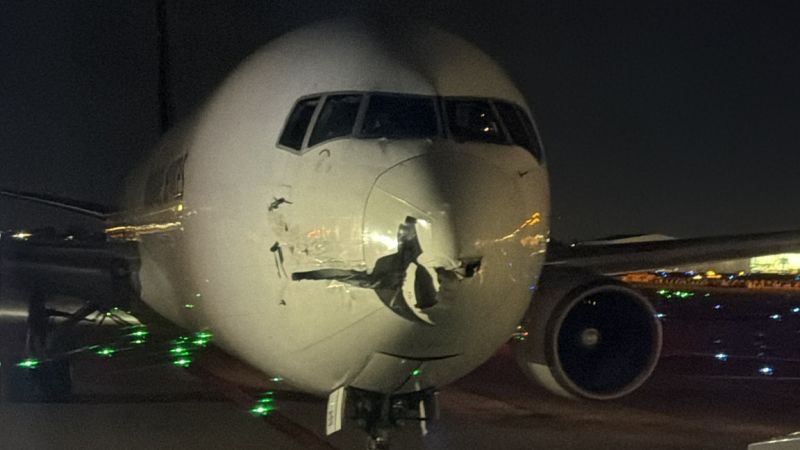
Two (2) Planes (Boeing 767 & 737) Have Collided At Miami Airport
Dimitris Gr
Pilot says ‘somebody hit us’..
A Boeing 767 and a 737 have collided while taxiing at Miami Airport, with dramatic air traffic control audio capturing the moment a pilot said, ‘somebody hit us.
Two aircraft have collided at a major US airport, with audio capturing the dramatic moment the incident occurred on the runway. The mishap reportedly took place at Miami International Airport on Saturday, November 14.
The collision appears to have involved two planes taxiing on the runway, between a UPS flight and a Copa Airlines that had just touched down in Florida.
On Air Traffic Control audio, the pilot of the commercial aircraft can be heard saying, “Somebody hit us.” From the Air Traffic Control Center, the operator says: “UPS 358, you’re supposed to give way to the 73 there. “Copy,” comes the reply. “358, Roger. We’re running checklist, runway change.” The air traffic controller is then heard asking: “UPS 358, did you hit that aircraft?”
In 1983, a tragic event shook the world when Korean Airlines Flight 007 was shot down by Soviet forces, killing all 269 passengers on board.
The incident, fueled by Cold War tensions, sparked international outrage and diplomatic turmoil, forever marking aviation history.
1988 – Pan American Flight 103
In 1988, tragedy struck when Pan American Flight 103 was downed over Lockerbie, Scotland, killing 270 people.
This brutal act of terrorism, orchestrated by Libyan agents, shocked the world and sparked international efforts to enhance aviation security measures.
1979 – American Airlines Flight 191
In 1979, American Airlines Flight 191 suffered a catastrophic engine failure, resulting in the deadliest aviation accident on US soil.
The DC-10 aircraft crashed shortly after takeoff from Chicago, claiming 273 lives and prompting crucial revisions in aircraft maintenance and safety regulations.
1988 – Iran Air Flight 655
In 1988, Iran Air Flight 655 tragically met its end when the US Navy’s guided-missile cruiser, USS Vincennes, misidentified the passenger jet and shot it down over the Persian Gulf. The incident claimed all 290 lives on board, sparking international outrage and diplomatic tensions.
1980 – Saudi Flight 163
In August 1980, Saudi Flight 163 made headlines as a devastating tragedy unfolded mid-air.
The Lockheed L-1011 TriStar, en route from Riyadh to Jeddah, caught fire shortly after takeoff, resulting in 301 casualties. The disaster raised questions about aviation safety and prompted industry-wide improvements.
2003 – Iran Ilyushin Il-76
In 2003, a tragic air disaster occurred when an Iranian Ilyushin Il-76 military aircraft crashed in southeastern Iran.
The catastrophe resulted in the loss of all 302 on board, primarily Iranian Revolutionary Guards. The accident was attributed to adverse weather and pilot error, igniting debates on aviation safety.
1974 – Turkish Airlines Flight 981
In 1974, Turkish Airlines Flight 981 suffered a catastrophic crash, claiming 346 lives.
The tragic event exposed a design flaw in the DC-10 aircraft’s cargo door, leading to industry-wide safety improvements and saving countless lives in future air travel.
1996 – Kazakhstan and Saudi Arabian Airlines
In 1996, Kazakhstan Airlines and Saudi Arabian Airlines inked a historic partnership, bolstering aviation ties between the two nations.
This collaboration significantly improved flight connectivity, economic growth, and cultural exchange, demonstrating the power of international cooperation in the aviation industry.
1985 – Japan Airlines Flight 123
On August 12, 1985, Japan Airlines Flight 123 faced a catastrophic disaster, becoming the deadliest single-aircraft accident in history.
The Boeing 747, en route from Tokyo to Osaka, suffered a critical structural failure, tragically claiming the lives of 520 passengers and crew.
1977 – Pan Am and KLM
In 1977, Pan Am and KLM marked their aviation legacies as both airlines showcased their prowess in international air travel.
Pan Am’s majestic Boeing 747s whisked passengers worldwide, while KLM expanded its pioneering European network, shaping a new era of global connectivity.